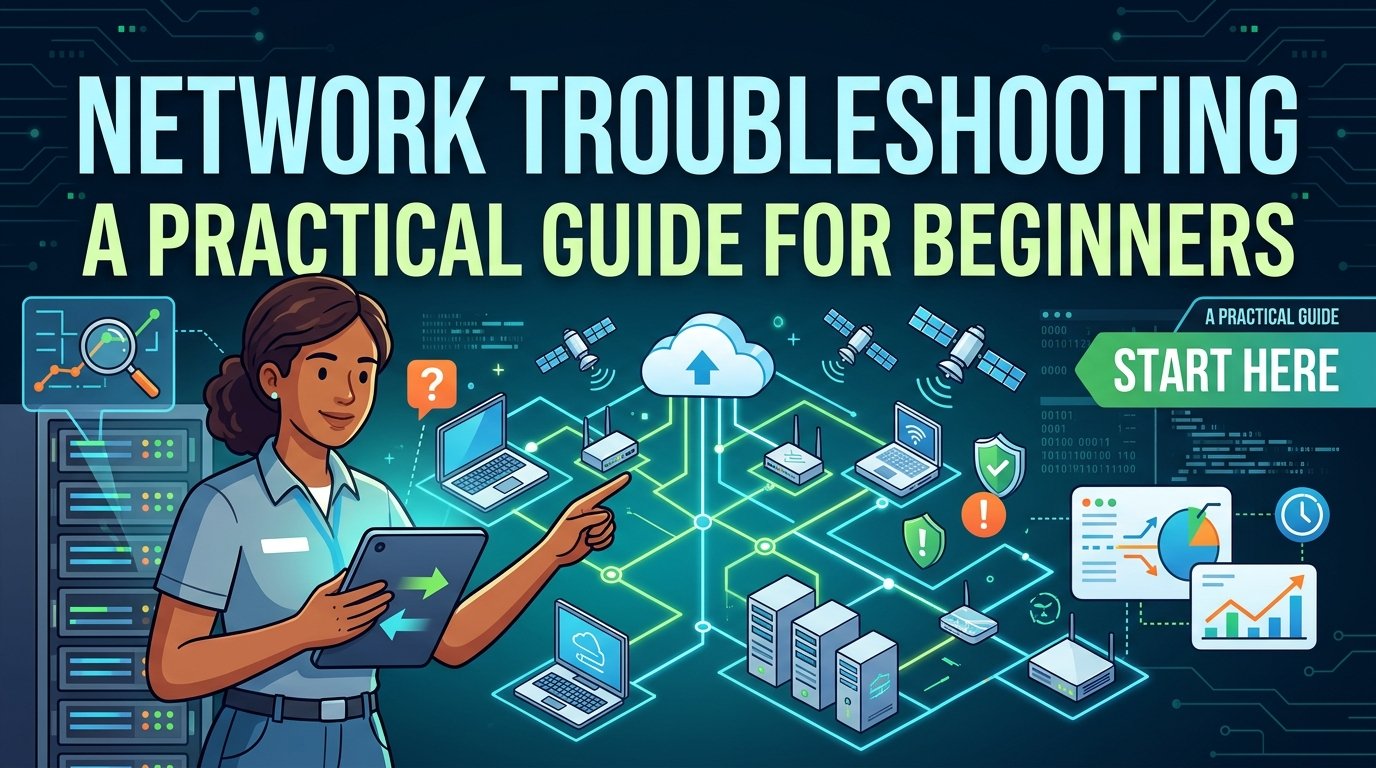
Network problems are among the most common issues faced by IT professionals, employees, and home users. A computer may suddenly lose Internet access, a website may not open, or a device may be unable to communicate with another computer.
The good news is that many network problems can be diagnosed using a simple and structured approach.
In this guide, we will learn the basics of network troubleshooting, explore common problems, and discover useful Windows commands that can help identify the cause of a network issue.
What Is Network Troubleshooting?
Network troubleshooting is the process of identifying, diagnosing, and resolving problems that affect communication between computers, servers, network devices, and the Internet.
A network problem can be caused by many different things, including:
- Faulty network cables
- Wi-Fi problems
- Incorrect IP configuration
- DNS issues
- Router or switch problems
- Firewall restrictions
- Network outages
- Incorrect gateway configuration
- Software or driver problems
The goal is not simply to restart the computer and hope the problem disappears.
A good IT technician follows a logical process to find the real cause.
Common Network Problems
Before starting troubleshooting, it is useful to understand the most common network problems.
A computer may show that it is connected to the network but cannot access the Internet.
Possible causes include:
- Incorrect IP address
- Missing default gateway
- DNS problems
- Router problems
- ISP outage
- Firewall restrictions
The first step is to determine whether the problem affects only one computer or multiple devices.
If several users have the same problem, the issue may be related to the network infrastructure rather than one computer.
A slow network can make websites, applications, file transfers, and remote systems difficult to use.
Possible causes include:
- Weak Wi-Fi signal
- Network congestion
- High bandwidth usage
- Faulty network equipment
- Poor-quality cables
- Background downloads
- Server performance problems
For example, if several users are downloading large files at the same time, available bandwidth may become limited.
Every device on an IP network needs a valid IP configuration.
A typical configuration contains:
- IP address
- Subnet mask
- Default gateway
- DNS server
If these values are incorrect, the computer may not be able to communicate correctly with other devices.
On Windows, you can check the configuration with:
ipconfigFor more information:
ipconfig /allBasic Network Troubleshooting Steps
When troubleshooting a network problem, avoid changing multiple settings at the same time.
Follow a simple process.
Step 1: Check the Physical Connection
Start with the simplest possible cause.
For a wired computer, check:
- Is the Ethernet cable connected?
- Are the switch port LEDs active?
- Is the cable damaged?
- Is the network adapter enabled?
For Wi-Fi:
- Is Wi-Fi enabled?
- Is the computer connected to the correct network?
- Is the signal strong enough?
Physical problems are easy to overlook.
Step 2: Restart the Network Connection
Sometimes a temporary network problem can be resolved by reconnecting the network adapter.
You can also restart the computer if necessary.
For Wi-Fi, disconnecting and reconnecting to the wireless network can help identify whether the issue is temporary.
However, restarting should not replace proper troubleshooting when the problem continues.
Step 3: Check the IP Configuration
Open Command Prompt and run:
ipconfigYou should see information similar to:
IPv4 Address. . . . . . : 192.168.1.25
Subnet Mask . . . . . . : 255.255.255.0
Default Gateway . . . . : 192.168.1.1
If the computer has an unexpected address, such as:
169.254.x.xit may indicate that the computer did not successfully receive an IP address from DHCP.
You can try:
ipconfig /releasefollowed by:
ipconfig /renewThen check the configuration again.
Step 4: Test the Local Network
The ping command is one of the most useful basic network troubleshooting tools.
First, test the local computer:
ping 127.0.0.1This checks the TCP/IP stack on the local machine.
Next, test the default gateway:
ping 192.168.1.1Replace the address with your actual gateway.
If the gateway responds, the computer is communicating with the local network.
Step 5: Test Internet Connectivity
If the gateway works, try pinging an external IP address:
ping 8.8.8.8If this works but a website name does not work, the problem may be related to DNS.
For example:
ping google.comIf 8.8.8.8 responds but google.com does not, investigate DNS configuration.
Step 6: Test DNS
DNS converts domain names into IP addresses.
For example:
google.comis resolved to an IP address by a DNS server.
Windows provides the nslookup command for testing DNS.
Run:
nslookup google.comA successful response should provide information about the DNS server and the resolved IP address.
If DNS resolution fails, check:
- DNS server configuration
- Network connectivity
- DNS service availability
- Firewall rules
- Local DNS cache
You can also clear the Windows DNS cache with:
ipconfig /flushdnsUseful Windows Network Commands
Windows includes several commands that are extremely useful for IT support and network troubleshooting.
ipconfig
Displays IP configuration.
ipconfigFor detailed information:
ipconfig /allping
Tests connectivity between devices.
ping 192.168.1.1It can help determine whether a device is reachable.
tracert
Shows the path packets take toward a destination.
tracert google.comThis can help identify where communication is failing or becoming slow.
nslookup
Tests DNS resolution.
nslookup google.comIt is particularly useful when websites cannot be reached by name.
netstat
Displays network connections and listening ports.
netstatYou can also use:
netstat -anoThis provides additional information, including process IDs.
Practical Troubleshooting Example
Imagine a user tells you:
“My computer is connected to the network, but I cannot access websites.”
Instead of immediately changing settings, follow a logical process.
1. Check the IP address
Run:
ipconfigVerify that the computer has a valid IP address.
2. Test the gateway
ping 192.168.1.1If the gateway does not respond, investigate the local network connection.
3. Test an external IP
ping 8.8.8.8If this fails, investigate Internet connectivity, routing, or the firewall.
4. Test DNS
nslookup google.comIf DNS fails while external IP connectivity works, investigate the DNS configuration.
This simple process allows you to narrow down the problem instead of guessing.
Network Troubleshooting Checklist
When a user reports a network problem, use this checklist:
- Check Ethernet or Wi-Fi connection
- Check network adapter status
- Check IP address
- Check subnet mask
- Check default gateway
- Check DNS configuration
- Ping the local machine
- Ping the default gateway
- Ping an external IP
- Test DNS resolution
- Check routing if necessary
- Check firewall rules
- Check whether other users are affected
A structured checklist can make troubleshooting much faster.
Common Troubleshooting Mistakes
Beginners often make a few common mistakes when diagnosing network problems.
Changing too many settings
Changing IP addresses, DNS servers, firewall settings, and router configuration at the same time makes it difficult to know what actually solved the problem.
Ignoring the physical layer
Always check cables, Wi-Fi, switch ports, and network adapters before moving to advanced configuration.
Assuming DNS is always the problem
DNS is important, but not every Internet problem is caused by DNS.
Not checking whether other users are affected
If twenty users cannot access the Internet, troubleshooting one workstation individually may waste time.
Always determine the scope of the problem.
When Should You Contact an IT Administrator?
Some problems require access to network infrastructure or administrative systems.
Contact a network administrator when you suspect:
- Switch configuration problems
- VLAN issues
- Router failures
- Firewall rules
- DHCP server problems
- DNS server problems
- ISP outages
- VPN problems
- Enterprise network configuration issues
A beginner should avoid changing production network infrastructure without authorization.
FAQ
What is network troubleshooting?
What is the first thing to check when the Internet is not working?
What does ping do?
ping tests whether a destination can be reached over the network and provides basic information about the response.Why is DNS important?
google.com into IP addresses that computers use to communicate.What does a 169.254.x.x address mean?
Conclusion
Network troubleshooting is an essential skill for anyone working in IT support, systems administration, or networking.
You do not need advanced tools to start diagnosing common problems. Commands such as ipconfig, ping, tracert, nslookup, and netstat can provide valuable information about what is happening on a network.
The most important principle is to troubleshoot logically.
Start with the simplest possibilities, test one thing at a time, identify where communication fails, and then focus on that part of the network.
With regular practice, these basic troubleshooting techniques become some of the most useful skills in an IT professional’s toolkit.